Modern buildings are expected to deliver high levels of comfort, health, and energy efficiency at the same time. Increasing occupancy density, flexible use of spaces, and stricter energy regulations place new demands on HVAC systems, particularly on ventilation control. In this context, demand-controlled ventilation based on real room conditions has become a key design strategy. Variable Air Volume systems, combined with intelligent
CO₂ control, provide a practical and scalable approach to meeting these requirements while maintaining full control over operating costs and indoor air quality.
Indoor Air Quality and the importance of CO₂ control
Indoor air quality has become one of the most important parameters in the design and operation of modern commercial and public buildings. Among the various indicators of air quality, carbon dioxide concentration
is widely used as a reliable measure of occupancy-related ventilation demand. Elevated CO₂ levels can negatively affect occupants’ comfort, concentration, and productivity, while excessive ventilation results in increased energy consumption and higher operating costs.
Variable Air Volume ventilation systems combined with CO₂-based demand-controlled ventilation provide an effective solution to this challenge. By adjusting the airflow to the actual needs of the room, these systems ensure an optimal balance between indoor air quality, thermal comfort, and energy efficiency.
CO₂-controlled VAV ventilation
In VAV ventilation systems, the supplied airflow is continuously modulated according to the current room demand. Traditionally, this demand is derived primarily from thermal loads related to heating or cooling. By introducing CO₂ concentration as an additional control variable, ventilation becomes directly linked to occupancy and actual indoor air quality conditions.
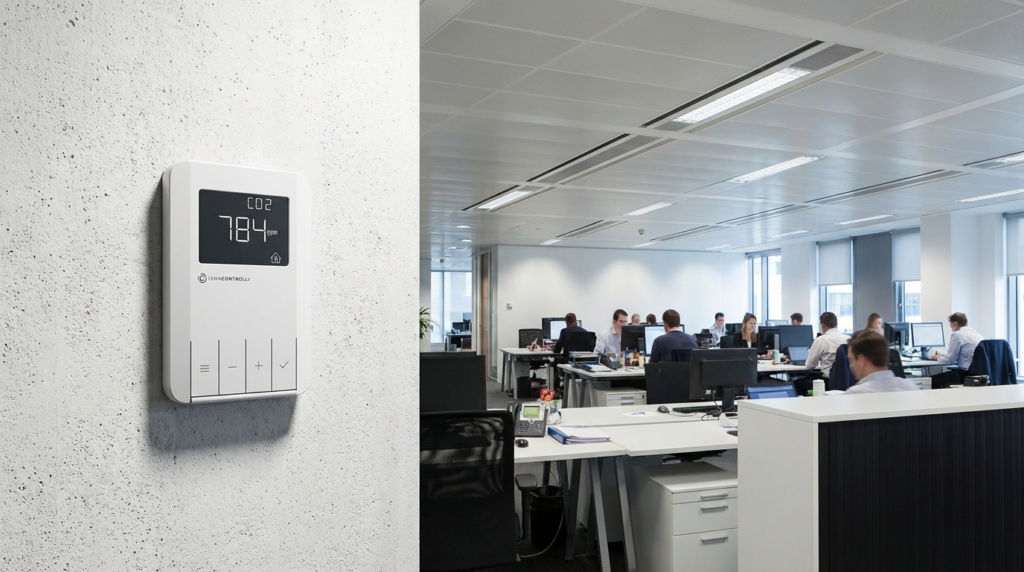
The measured CO₂ level reflects the number of occupants and their activity within the space. When CO₂ concentration increases, the required ventilation rate rises accordingly, and the VAV controller increases the airflow to maintain acceptable air quality. During periods of low occupancy, the airflow is reduced, preventing unnecessary energy use. As a result, CO₂-controlled VAV systems deliver fresh air precisely when and where it is needed.
Flexible control for ventilation
The VAV14-IP controller has been developed to meet the demands of advanced VAV applications where flexibility and performance are essential. Its compact design and powerful control capabilities allow it to manage airflow accurately while supporting sophisticated application logic for demand-controlled ventilation. To minimize engineering effort and simplify the commissioning process, the controller is equipped with a pre-loaded application that supports the most commonly used types of VAV boxes.
Configuration options
- VAV / VVT systems
- VAV cooling
- VAV cooling/heating
- VAV cooling with electrical reheater
- VAV cooling with water reheater
with optional perimeter - VAV cooling with 2 staged electric reheaterwith optional perimeter
- Series fan powered VAV cooling
with water reheater with optional perimeter - Series fan powered VAV cooling
with 2 staged electric reheater
with optional perimeter - Parallel fan powered VAV cooling with water reheater with optional perimeter
- Parallel fan powered VAV cooling
with 2 staged electric reheater with optional perimeter
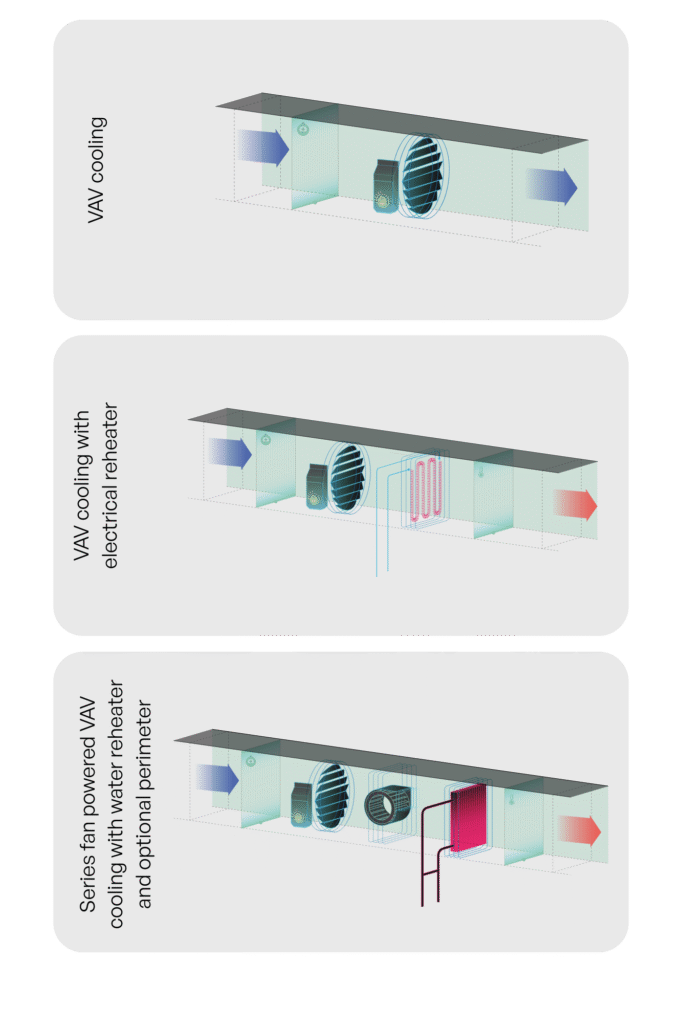
In CO₂-driven applications, the controller continuously calculates the required airflow setpoint based on both thermal conditions and indoor air quality parameters. By combining these inputs within a single control platform, the VAV14-IP ensures that comfort and air quality requirements are met under all operating conditions.
The room CO₂ concentration control loop adjusts the airflow in response to the measured CO₂ level within the space. This control loop has a priority effect on the calculated airflow setpoint, meaning that indoor air quality requirements take precedence over thermal demands. When the CO₂ concentration exceeds the defined threshold, the controller increases the airflow to ventilate the room effectively, even if the cooling or heating demand alone would require a lower airflow rate.
As a result, the airflow can be higher than that required purely for temperature control. This approach ensures that sufficient fresh air is supplied whenever occupancy levels rise, regardless of the current thermal load. In situations where no CO₂ sensor is installed in the room, the CO₂ control loop remains inactive and does not influence the airflow setpoint. In this case, the controller operates solely based on heating and cooling demand, maintaining stable and predictable system behavior.
Local room control and user comfort
The Control Point CP-VAV is a dedicated room operating unit designed to complement the VAV14-IP controller in CO₂-based applications. Installed directly in the occupied space, it provides both measurement and user interface functions at the room level. The panel can be connected to the controller using a single RJ45 cable with SmartPlug™ technology, which combines RS485 communication and power supply in one cable. This solution simplifies wiring, reduces installation time, and minimizes the risk of connection errors.
By allowing occupants to view air quality information and adjust comfort-related parameters like temperature setpoint, the CP-VAV enhances user comfort without compromising system efficiency.
In a typical application, the CO₂ sensor or Control Point CP-VAV supplies air quality data to the VAV14-IP controller, which processes this information together with pressure sensor inputs to calculate the required airflow. The controller modulates the VAV damper accordingly, maintaining the desired balance between ventilation and thermal comfort.
The system can operate autonomously at the room level while also being connected to a building management system via BACnet or Modbus for monitoring, optimization, and coordination at the building scale. This distributed intelligence approach increases system reliability and simplifies commissioning and operation.